Sola vs. Noda: Which is the Best Gateway for High-Risk Businesses?
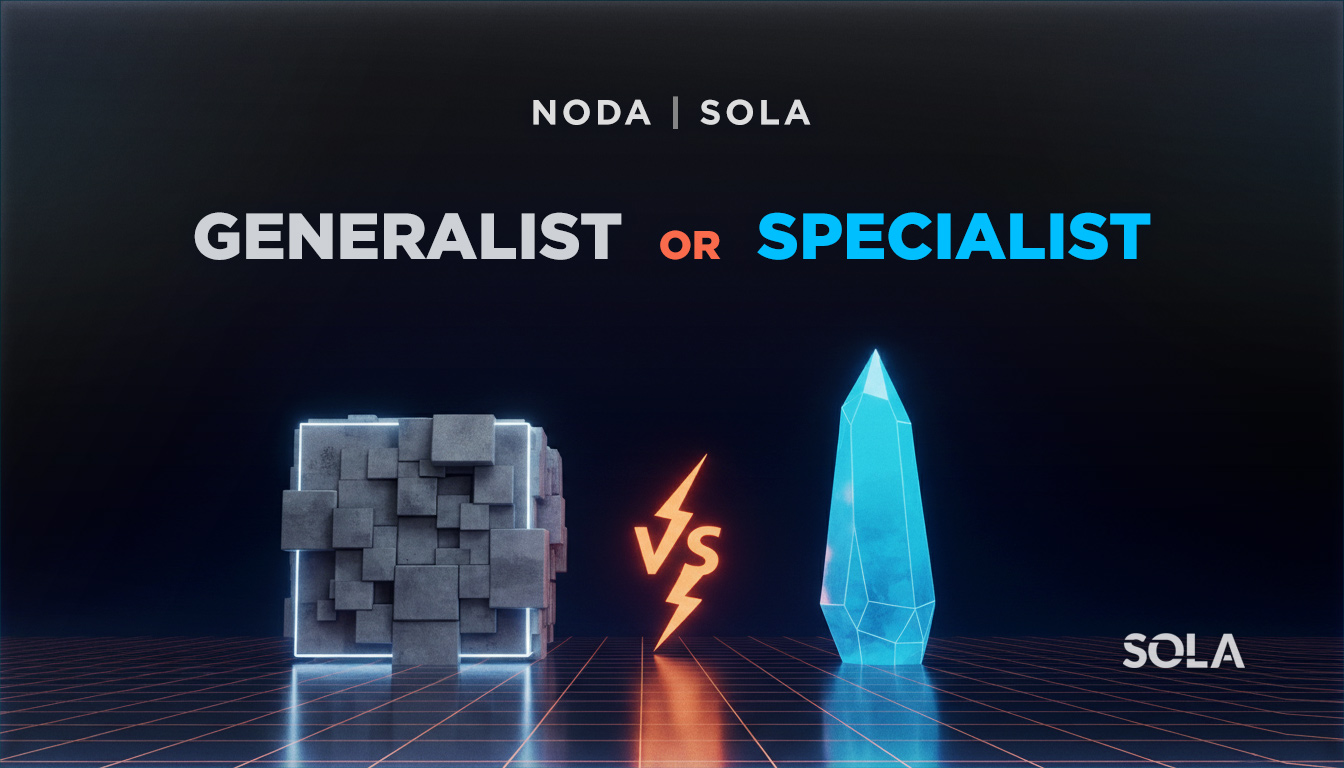
Introduction: The Generalist Titan vs. The Specialist Challenger
In the sprawling ecosystem of European Open Banking, Noda stands as a formidable incumbent. With a client roster that includes major publishers like Wargaming and a platform engineered for massive scale, they have successfully positioned themselves as the default utility for high-volume merchants. If your business model fits neatly into a standard risk box—selling software, travel, or low-variance gaming items—their automated onboarding and AI-driven optimization are undeniable assets. They are the “Generalist Titan” of the sector: efficient, expansive, and built for speed.
However, for the Chief Risk Officer of a regulated iGaming operator or a crypto exchange, “standard” is often a synonym for “vulnerable.” The strategic calculus changes entirely the moment your business crosses the threshold into the high-risk category. Here, a payment strategy built on mass-market aggregation can become a structural liability. The very automation that allows Noda to scale can become a choke point for operators with complex ownership structures or multi-jurisdictional licensing needs (e.g., Curacao-Cyprus hybrids).
This is where the Sola vs Noda distinction moves from feature comparison to existential selection. It is a choice between a platform designed for broad market capture and a specialist partner engineered for vertical resilience. While Noda optimizes for friction-free volume, Sola optimizes for MID survival and regulatory defense. This briefing delivers a forensic high-risk payment gateway comparison, stripping away the marketing gloss to determine which infrastructure can actually withstand the scrutiny of 2025. To understand the baseline mechanics governing this terrain, review The Complete Guide to Open Banking for European Businesses.
The Core Difference: A Tale of Two Philosophies
At its core, the Sola vs Noda debate is not about features; it is a clash of opposing operational philosophies. Noda operates as the digital equivalent of a hyper-efficient supermarket. Their model is predicated on velocity and aggregated volume, utilizing sophisticated algorithms to ingest thousands of merchants with minimal friction. This approach is brilliant for standard e-commerce, where risk variance is low and business models are uniform. In that environment, standardized automation lowers costs and accelerates deployment.
However, in the high-stakes arena of regulated verticals, that same automation becomes a structural vulnerability. “Scale” often comes at the cost of nuance. A mass-market risk algorithm sees a sudden spike in transaction volume during the Champions League final as a potential fraud anomaly to be blocked. Sola, operating as a precision boutique, recognizes it as a successful marketing campaign to be supported.
Our approach to merchant underwriting is deliberately manual and forensic. We do not rely on binary “pass/fail” scripts that reject complex corporate structures. Instead, we dissect the specific interplay between your licensure (e.g., Curacao, Anjouan) and your processing history to build a custom risk profile. We understand that a complex web of subsidiaries is often a requirement of international tax planning, not a red flag for money laundering. This specific depth makes Sola the definitive Noda alternative for igaming operators who cannot afford to have their liquidity choked by a generalist risk bot that fails to understand the mechanics of their industry. For a deeper analysis of these vertical-specific requirements, consult A Guide to iGaming and Forex Payment Processing.
Head-to-Head: Underwriting and Regulatory Expertise
The moment you click “Apply” on a payment gateway, the clock starts ticking. Noda has optimized this experience for speed, utilizing an automated underwriting stack that leverages AI to ingest documentation and render decisions in hours. For a standard SaaS platform or a low-risk e-commerce store, this velocity is an asset. The system scans for standard flags, checks basic AML databases, and issues an API key.
However, for the high-risk principal, this automation is a hidden liability. Noda’s “Risk Appetite Policy” explicitly subjects verticals like “Online Gambling Services,” “Forex Trading,” and “Virtual Asset Services” to stringent review. In practice, automated underwriting engines often lack the nuance to distinguish between a legitimate complex corporate structure (e.g., a Curacao-licensed operator with a Cypriot payment agent) and a shell company masking money laundering. When an algorithm encounters a document it cannot parse against a standard template, the default output is rejection.
Sola operates on a fundamentally different cadence. We reject the “black box” underwriting model in favor of a consultative, manual review process. We understand that in high-risk verticals, the corporate map is the territory. Our compliance teams are not just trained in generic EU PSD2 regulations; they possess specific, granular expertise in the regulatory frameworks of key iGaming hubs like CySEC (Cyprus) and the MGA (Malta).
We know that a license in Anjouan requires different due diligence documentation than a UK GC license, and we know how to package that reality for our banking partners. While Noda’s generalist approach restricts them to “safe” banking lines that may pull the plug at the first sign of regulatory noise, Sola curates a network of acquirers who specifically have an appetite for this complexity. We trade instant automated approval for sustainable, long-term stability—ensuring your MID doesn’t vanish overnight because an algorithm flagged a false positive.
Head-to-Head: Fraud Prevention and Chargebacks
In the standard e-commerce landscape, fraud prevention is a game of stopping stolen credit cards. Noda’s platform excels here, deploying a robust, standard-issue security stack—velocity checks, IP geolocation, and 3D Secure challenges—that effectively filters out the noise of retail card testing. For a fashion retailer or a SaaS platform, this defensive layer is sufficient.
However, the threat landscape for high-risk merchants is fundamentally different. In iGaming and Forex, the primary adversary is not the identity thief, but the opportunistic customer. Friendly fraud (first-party misuse) and bonus abuse (multi-accounting) account for the vast majority of revenue leakage. A generalist tool like Noda’s often fails to distinguish between a legitimate “whale” depositing rapidly to chase losses and a fraudster draining a stolen card. Consequently, their rigid velocity filters frequently trigger false positives, blocking your most valuable VIP players at the critical moment of conversion.
Sola’s infrastructure is engineered to solve these specific high-variance vectors. We do not just block transactions; we analyze behavioral biometrics to identify multi-accounting rings attempting to exploit welcome bonuses. Furthermore, our stack includes integrated chargeback mitigation protocols (such as Ethoca and Verifi alerts) that allow you to refund a disputed transaction before it evolves into a formal strike against your MID. While Noda views a chargeback as a compliance failure, we view it as an operational reality to be managed. By filtering for the nuances of gaming behavior rather than generic retail patterns, Sola protects your bottom line without strangling your top-line revenue.
Head-to-Head: Acquiring Network & MID Stability
The most dangerous number in high-risk payment processing is “one.” For the prudent Chief Risk Officer, reliance on a single aggregator represents an unacceptable concentration risk. While Noda provides a robust technical layer, their model inherently functions as a central gatekeeper. They hold the master keys to the banking relationships. The danger here is structural: if Noda’s upstream sponsor bank decides to de-risk a specific vertical—say, ceasing support for Curacao-licensed casinos or restricting crypto on-ramps—the policy shift cascades instantly down to your account. You face immediate termination not because of your specific performance, but because the “Supermarket” decided to close that aisle.
Sola operates on a philosophy of multi-acquirer redundancy. We do not force your volume through a single choke point. Instead, we architect a distributed mesh of banking partners expressly chosen for their uncorrelated risk appetites. If one acquirer tightens their compliance posture or experiences technical downtime, your traffic is not blocked; it is simply rerouted to a secondary MID that is already warm and active.
This approach transforms your payment stack from a dependency into an asset. We ensure MID stability by diversifying your exposure across multiple jurisdictions and banking licenses, immunizing your revenue against the whims of any single financial institution. In the high-risk arena, this continuity is the difference between a minor operational hiccup and a total revenue stoppage. For further analysis on building resilient stacks, review our report on the 5 Best Noda.live Alternatives for Regulated Industries.
The Verdict: A Summary for the C-Suite
For the executive decision-maker, the final determination in the Sola vs Noda analysis is not a question of technical competency—both platforms deliver robust open banking rails. The decision rests entirely on your risk profile. Noda is the superior engine for standard, low-variance commerce where speed is the primary metric. Sola is the necessary partner for regulated, high-variance sectors where survival is the primary metric.
Use this decision matrix to align your infrastructure with your business reality:
| Decision Criterion | Choose Noda If… | Choose Sola If… |
|---|---|---|
| Business Model | You run a standard e-commerce, SaaS, or travel platform with low regulatory scrutiny. | You operate in iGaming, Forex, Crypto, or Adult sectors with complex licensing. |
| Strategic Priority | You need instant, automated onboarding to go live within 24 hours. | You require long-term MID stability, chargeback defense, and bank redundancy. |
| Primary Challenge | You are optimizing for massive scale and minimizing marginal transaction costs. | You are navigating complex cross-border compliance, “friendly fraud,” and de-risking threats. |
If your operation fits the column on the right, reliance on a generalist aggregator is a strategic error. You require a specialist architecture built to withstand the specific pressures of your vertical.
Conclusion: Choosing a Partner, Not Just a Platform
In the final analysis, the Sola vs Noda decision is a litmus test for your operational maturity. Noda is an exceptional utility for the mass market—a powerful, automated engine for low-stakes volume. But in the volatility of high-risk verticals, a utility is insufficient; you require a strategic partnership. When regulators tighten the screws or fraud spikes, an automated chatbot cannot save your MID. You need human expertise that understands your specific threat landscape.
As the definitive Noda alternative for igaming and high-variance sectors, Sola offers more than just API keys; we offer survival. Do not settle for a vendor that treats your license as a liability. Contact Sola today for a bespoke consultation and secure a payment stack designed to withstand the realities of your business.